Program targets circularity, biodiversity, sourcing, and climate for employees across functions.
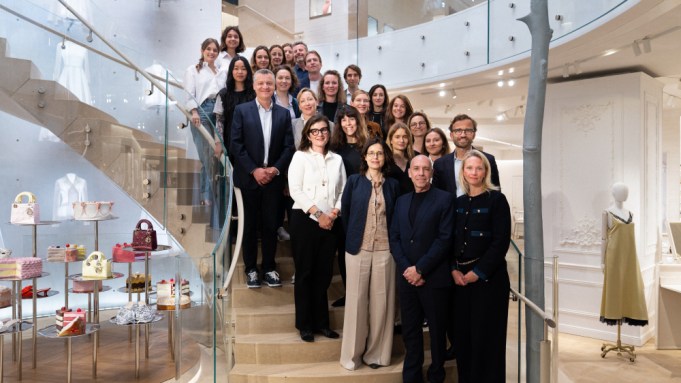
Christian Dior Couture has partnered with the Institut Français de la Mode to launch a sustainability training initiative for employees worldwide. The Sustainability Fashion Leadership Program was unveiled in late May.
The program is part of Dior’s “Dream in Green” strategy and aligns with LVMH’s Life 360 environmental roadmap. Goal: embed sustainability across all business functions and translate environmental commitments into practical action.
Program Structure
Dior said the training will give employees access to sustainability-focused conferences and educational content developed with IFM, the French fashion and luxury education institution. Topics span design, merchandising, logistics, finance, legal, and supply chain operations.
A certified one-year training track has been created for a first cohort of 23 employees drawn from more than 15 departments. The curriculum is structured around four modules covering regulation, responsible sourcing and manufacturing, traceability, biodiversity, eco-design, circularity, climate, and sustainable performance. Participants will also receive coaching to develop projects for internal implementation.
Leadership Perspective
Clément Lefevre, chief sustainability officer at Christian Dior Couture, stated: “With ‘Dream in Green,’ we aim to train all our employees so that everyone can have a positive impact within their position. This training program, developed in collaboration with IFM, is thus designed as a driver for action, allowing teams to translate the house’s vision into concrete, innovative and meaningful initiatives.”
17th edition brings 140 speakers and global industry leaders together for three days of programming.
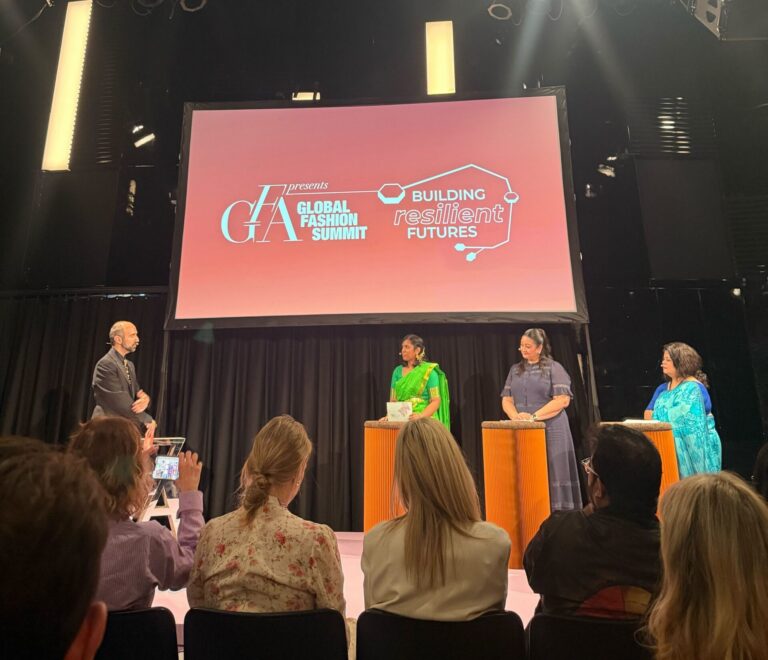
Global Fashion Agenda hosted its 17th annual Global Fashion Summit in Copenhagen earlier this month. Host Arizona Muse and CEO Federica Marchionni led programming that featured 140 speakers and hundreds of attendees from across the fashion value chain.
Finance and Risk Take Center Stage
Financing sustainability was a key theme. A session included H&M Group’s head of green investment Ulrika Leverenz, BESTSELLER’s head of sustainability Dorte Rye Olsen, Kering’s sustainable finance director Laurence Barrère, and Boston Consulting Group’s managing director Catharina Martinez-Pardo.
The discussion accompanied GFA’s “Fashion CFO Agenda 2026: Building Financial Resilience Through Sustainability” report produced with BCG. The report was among several GFA-authored releases during the week focused on impact measurement and policy.
Speakers emphasised deeper involvement from finance teams in sustainability. Olsen highlighted the need to integrate sustainability beyond dedicated ESG functions. Leverenz framed sustainability as enterprise risk management rather than a separate initiative.
Retail, Resilience, and Consumer Shifts
In a conversation between Marchionni and Chalhoub Group’s executive chairman Patrick Chalhoub, the focus turned to retail amid geopolitical shifts. Chalhoub noted: “The human being has this level of resilience and reinventing itself.” Cost-cutting, sourcing shifts, and supply chain efficiency were cited as ongoing lessons in an evolving business landscape.
Materials and Consumer Awareness
In “Redefining the Diamond,” Pandora’s marketing chief Jennifer Farmer and celebrity ambassador Pamela Anderson discussed “romantic activism” and consumer awareness. Anderson noted young consumers understand carbon footprinting. Farmer spoke to growth in lab-grown diamonds and their cited lower carbon footprint.
Labour, Data, and Women’s Health
Speakers across sessions called for brands to integrate labor and climate indicators into supply chain and enterprise risk strategies. A session with Janet Mensik, CEO of the Social & Labor Convergence Program (SLCP), highlighted SLCP’s Converged Assessment Framework (CAF). Mensik noted approximately 15,000 facilities currently use the framework globally and flagged collaborative work with GFA on pay equity research focused on Turkey.
A side session, “Fashion, Climate & Women’s Health,” convened Dr. Harshita Umesh, founder of Vaada Hope Foundation; Rawnak Jahan, director of women and youth programming at CARE Bangladesh; Farhana Islam, quality inspector at Tusuka Trousers Ltd.; and Tiffany Rogers, VP of research and development at Fair Labor Association. Dr. Hakan Karaosman moderated.
Umesh shared stories from emergency rooms where garment workers faced finger infections, respiratory illness, tuberculosis, and other gender-based health issues linked to working conditions. Her statement framed the session: “I’m treating the consequences of a system of an industry that has refused to address these injustices.”
Three-Day Scope
Programming covered finance, policy, artificial intelligence, luxury retail, consumer behaviour, and more across the three-day summit.
Madrid summit brings 250 textile and apparel leaders together to confront compliance, data gaps, and textile waste.
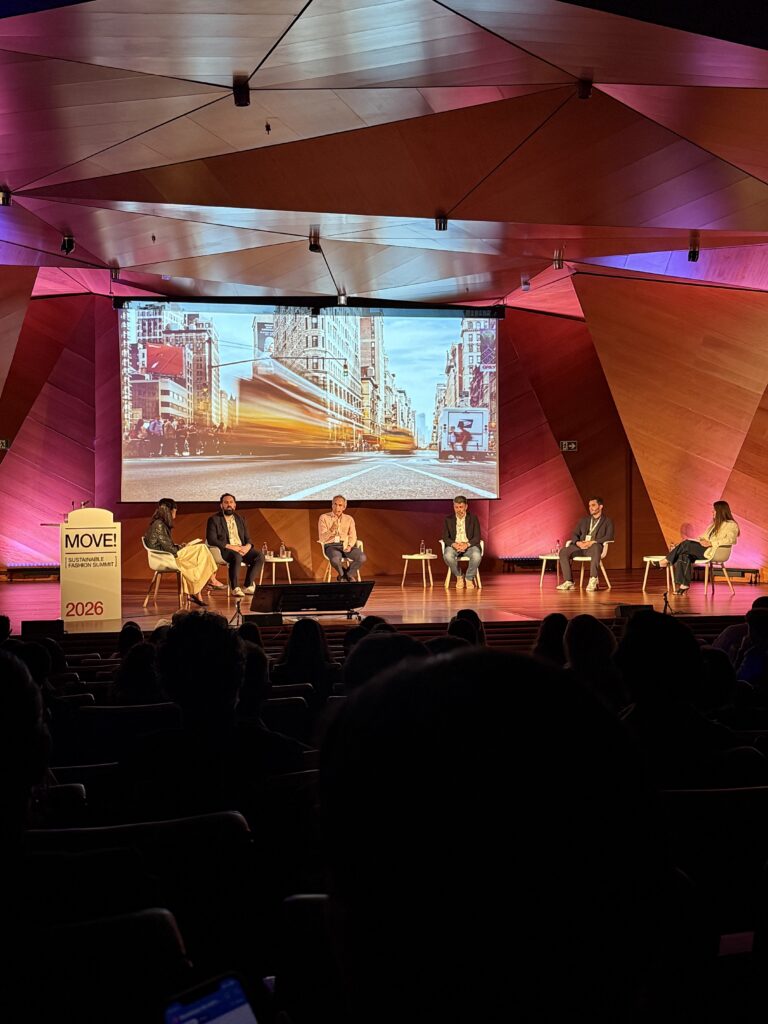
The Move! Sustainability Fashion Summit 2026 took place recently in Madrid, Spain, gathering approximately 250 professionals from across the textile, apparel, and footwear value chain. Discussions focused on circular systems, textile waste, business resilience, and the operational realities of sustainability.
Key Takeaways
Sustainability is now compliance, not choice
Across sessions, a clear shift emerged: sustainability is moving from strategic differentiator to business requirement. Evolving regulations are pushing companies to treat it as a baseline for operation, not a marketing edge.
Data and infrastructure remain bottlenecks
Fragmented data systems and limited infrastructure continue to slow progress toward circularity. Speakers pointed to ongoing challenges with traceability and harmonized measurement as major barriers to scale.
Collaboration is non-negotiable Industry leaders emphasized that addressing textile waste and scaling solutions will require coordination across the entire value chain. No single player can close the loop alone.
From Ambition to Operations
Speakers from H&M, the Ellen MacArthur Foundation, ReHubs, Pangaia, and the Regenerative Fund for Nature shared perspectives on circular business models, post-consumer textile waste, regenerative production, and the infrastructure needed for industry-wide transformation.
Several discussions highlighted the gap between circularity goals and current operations. While brands are investing in resale, collection, and recycling, challenges persist around traceability, data fragmentation, and limited recycling capacity. Industry experts noted that textile-to-textile recycling remains below 1% globally, underscoring the scale of work ahead.
Roundtable conversations also examined the link between sustainability investment and business performance. Participants noted that consumers continue to prioritise quality, design, and value, with sustainability increasingly expected as standard rather than a primary purchase driver.
The Road Ahead
The summit reinforced what many in the industry already know: progress depends on credible sustainability data, harmonized measurement tools, and deeper collaboration across suppliers, brands, and recyclers. With regulation tightening, the conversation is shifting from “why” to “how”.
Jeff Bezos and Lauren Sánchez have put $34 million behind a simple, stubborn problem: most of our clothes are made from oil.
Through the Bezos Earth Fund, the couple is funding the development of plastic-free, biodegradable textiles — alternatives to polyester and viscose that dominate fashion but pollute long after we’re done wearing them. Polyester is petroleum. Viscose is water-hungry and chemical-heavy. Both shed microplastics. Both were built for speed and scale, not for return to the earth.
So the money goes to labs at Columbia, UC Berkeley, and Clemson, where scientists are growing fibers from bacteria and spinning new life from agricultural waste. The goal isn’t a single miracle fabric. It’s a wardrobe of options that feel like silk or cotton, perform beautifully, and disappear without a trace.
This is a shift. The Earth Fund’s $10 billion climate pledge has, until now, flowed toward forests and conservation. Now it’s moving into the factory, because textiles drive up to 4% of global emissions — and the fiber is where that footprint starts.The challenge is familiar to any woman who’s tried to shop “better.”
These new materials are expensive. They’re not yet at scale. And the industry still reaches for polyester because it’s cheap, available, and stitched into every supply chain. Innovation exists. Adoption lags.There’s a quiet irony, too.
Bezos chairs Amazon, one of the world’s largest clothing sellers, a company facing its own questions about waste and overproduction. The Fund is independent, but the tension lingers: can new fibers fix fashion if we keep making at the same pace?Maybe not.
But materials matter. $34 million won’t reweave the industry overnight. But it’s a bet that the next story we wear might start not with oil, but with something that can return to the soil.
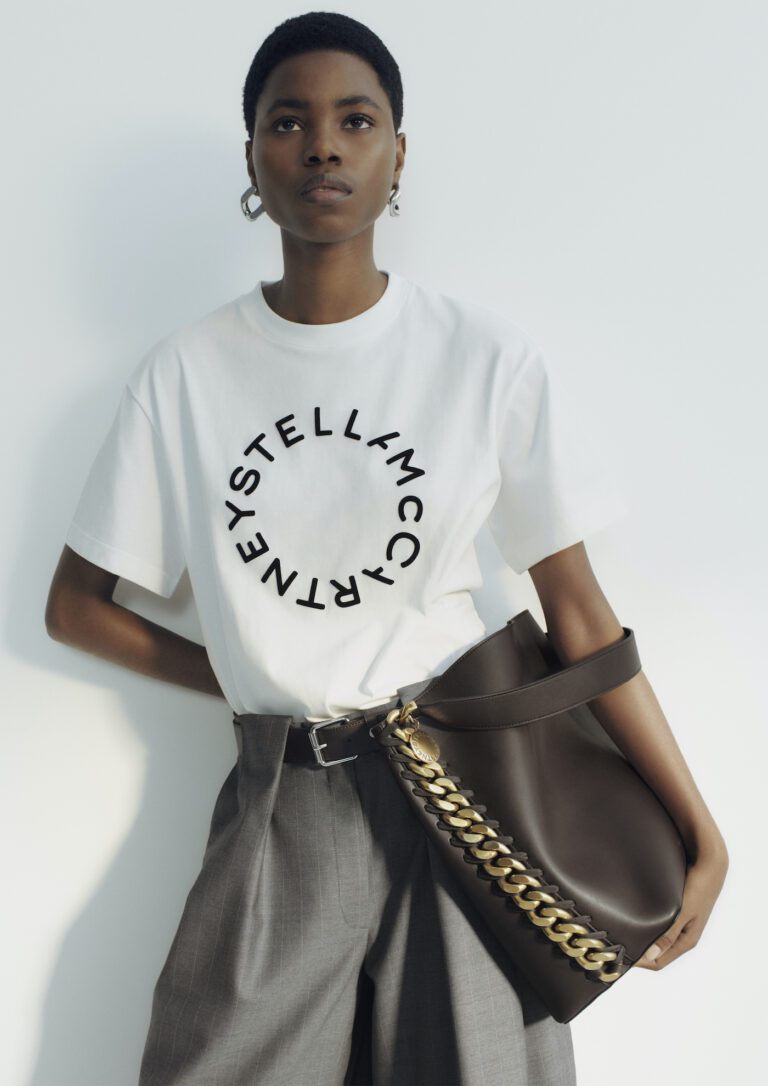
Stella McCartney returns to H&M in May with a sustainable capsule aimed at the high street, but the trade story is less about the “Rock Royalty” T-shirt (£37.99) and more about what happens when a luxury designer’s material standards hit a 3-billion-unit supply chain.
The collection includes oversized pinstripe tailoring — blazer (£259.99) and trousers (£139.99) — made from wool certified to Responsible Wool Standard (RWS). A comparable McCartney mainline set retails above £1,000. The price drop comes from H&M’s scale, not a standards drop, McCartney says: “This is not the cheapest of the cheap because there is a price that comes with doing anything good. But it’s an access area for more people.”
McCartney frames the capsule as “one for those that don’t know what sustainable means.” For the industry, it’s a test: Can a fast-fashion retailer integrate higher-spec inputs without reverting to lowest-cost substitution under margin pressure?
Ann-Sofie Johansson, H&M’s creative adviser, credits McCartney’s first 2005 collab for shifting H&M toward organic and recyclable cotton. “I also wanted to introduce them to my suppliers that champion sustainability,” McCartney said. “When H&M put in an order, it is meaningful, it can be life-changing for an innovator.”
“I hate how elitist the fashion industry is,” McCartney said. “I want a younger and wider audience to have access to my stuff.” For _Fabric and Garment_ readers, translate that: she’s using H&M’s order book to pull certified and next-gen materials into price brackets most consumers actually pay.
The collection drops in May. Twenty-one years after her first H&M sell-out, the metric to watch isn’t units moved. It’s whether the RWS, rPA, and bio-plastic specified here show up in H&M’s core lines 12 months later.
Visa and Global Fashion Agenda (GFA), are proud to support the next wave of creative entrepreneurs who are paving the way for a more regenerative fashion economy. The Circular Design Challenge is a global initiative that celebrates and empowers emerging designers to rethink living choices and accelerate the transition to a more sustainable future.
What Will Winners Receive?
15 winners will be selected to receive a range of prizes, including:
10 winners will receive a share of EUR 50,000 to invest in their business
4 winners will receive EUR 10,000 each to invest in their business, plus:
Invitation to participate in Global Fashion Summit 2026
Individual pairing with leading solution providers to co-create a product
Expert mentorship sessions, promotional opportunities, and industry recognition
1 Grand Prize Winner will receive EUR 20,000 to invest in their business, plus:
Invitation to participate in Global Fashion Summit 2026
Individual pairing with leading solution providers to co-create a product
Expert mentorship sessions, promotional opportunities, and industry recognition
Who Can Apply?
To apply for the awards, you must:
Be a creator, working in fashion upcycling, textiles, accessories/footwear, or apparel
Have been registered as a business owner for at least one year
Be headquartered in Europe and operate primarily within Europe
Operate in a way that is in line with circular business activities — including Resell, Repair, Rental, Refill, Return and Redistribute
Be available for the Global Fashion Summit on 6-7 May 2026 in Copenhagen if shortlisted
Apply Now!
Don’t miss this opportunity to join the circular fashion revolution! Apply now and showcase your innovative design and contribute to a more sustainable future.
Selection Process
Applications will be shortlisted and reviewed by an esteemed Jury of industry experts.
Rules and Regulations
Applicants must only submit original work, and any design must not be a copy of another company’s existing work. If the work was produced in collaboration with another party or individual, applicants must provide appropriate credit.