Kampala artisans turn byproduct into pieces rooted in Ugandan heritage.
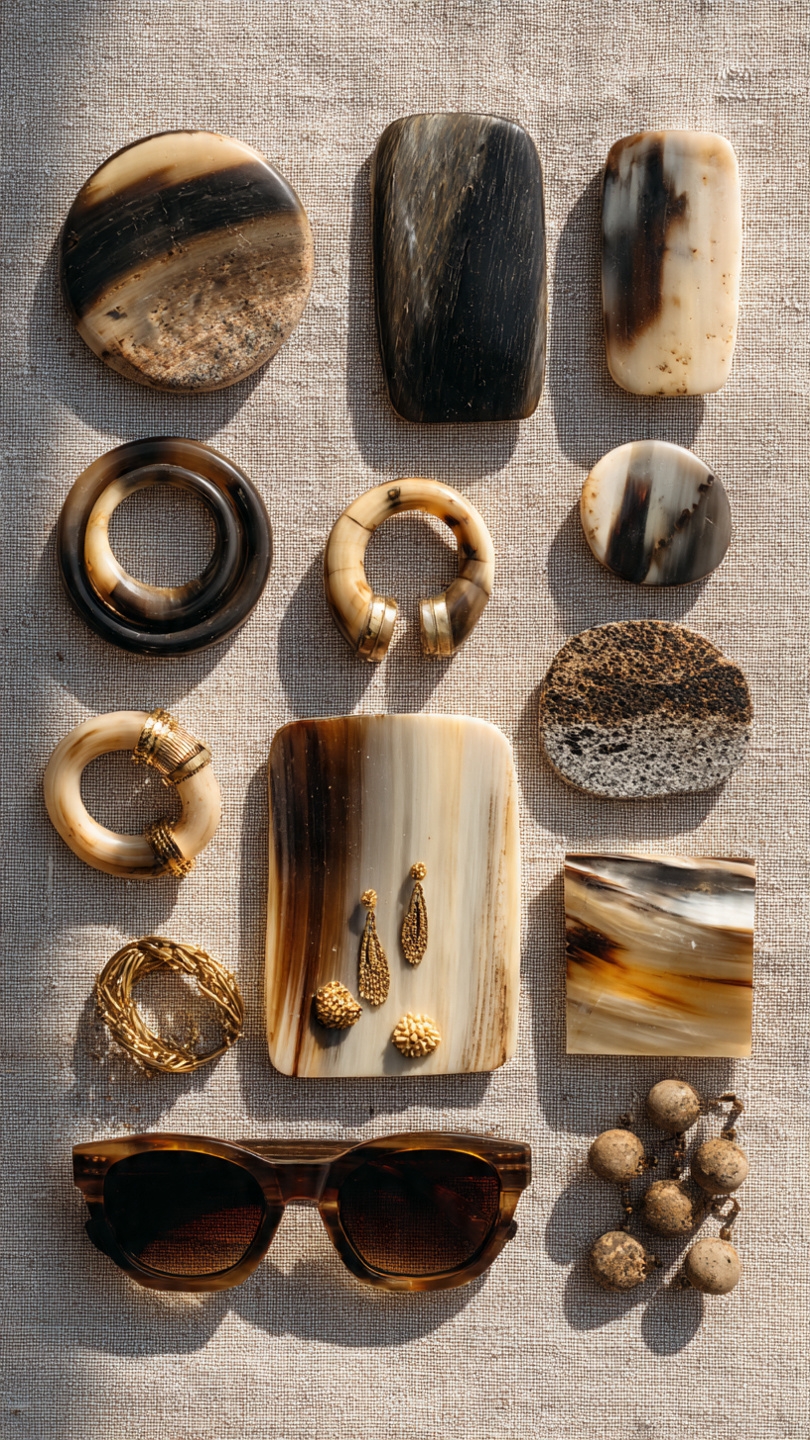
In a small workshop in Kampala, founder Sandra Kekirunga turns Ankole cow horn into statement jewellery. Ihato is a Ugandan accessories brand working with horn, reclaimed brass, paper beads, and banana fiber. The brand focuses on bold cuffs, layered necklaces, and bangles carved by hand.
No molds, no mass production. Just heat, skill, and material that already existed. Ihato works with repurposed material in a craft tradition common in East Africa.
From Pasture to Product
Ihato uses Ankole cow horn. Ankole cattle, native to Western Uganda, are known for their large, curved horns. The horns come from cattle already slaughtered for meat and dairy.
In Ihato’s workshop, the horns are cleaned, boiled, cut, and flattened with heat and pressure. No harsh chemicals. Once cooled, the horn holds its shape. The marbling shifts from deep brown to black to amber, so no two bangles or earrings are identical. That variation comes from the material itself.
Horn is paired with reclaimed brass from Kampala’s metal markets, hand-rolled paper beads, and banana fiber. Materials are sourced locally and processed by hand.
Heritage in Form
The designs reference Ugandan adornment traditions. Wide cuffs and layered beads echo styles seen across Western Uganda. The pieces are made for daily wear – office, gallery, wedding, or everyday.
Sustainable by Design
Ihato operates as a low-energy, artisanal workshop. Human craftsmanship replaces machines. The materials are upcycled byproducts, so the environmental cost is collection and craft, not extraction.
For decades it was written off as rustic, replaced by plastic and resin. Now cow horn is slipping back into fashion’s vocabulary. It comes from a natural byproduct, carries unique marbling in every piece, and ages better than anything synthetic.
From buttons that ground a coat to sunglasses that catch light like tortoiseshell, designers are choosing it again for its strength, texture, and zero-waste story. It’s not a trend chasing attention. It’s a material remembering its value. After years of uniformity, fashion is circling back to something real. Cow horn isn’t new. It’s just back.
What cow horn actually is
Cow horn is a byproduct of the meat and dairy industry. It grows like fingernails, and it’s harvested after slaughter. No one’s raising cows just for their horns.
Once separated, the horn is cleaned, cut, and shaped using heat and pressure. No harsh chemicals are needed. When heated, horn becomes pliable. Cool it down and it holds the shape permanently.
The result is a material that looks like tortoiseshell or amber, but with natural marbling that’s impossible to fake. No two pieces are identical.
Why it disappeared, and why it matters now
Plastic killed horn for the same reason it killed most natural materials: scale. Injection molding is fast. Horn needs heat, hand-finishing, and skill.
But scale is exactly what got us into 92 million tons of textile waste a year. And plastic’s other problem is longevity. It’s durable in the wrong way — it sits in landfills for centuries.
Horn is different. It’s biodegradable. It’s strong. It ages well. A horn button on a coat won’t fall apart after 10 washes. A horn comb won’t melt if you leave it in a hot car.
Where it shows up today
You’ll find cow horn mostly in places where small details matter: buttons on coats, eyewear frames, combs, hair accessories, jewelry, knife handles, home goods.
It’s not trying to compete with polyester on price. It’s competing on lifespan. The pitch is simple: buy it once, keep it 20 years. That’s a harder sell on Instagram, but it’s what “sustainable” actually looks like in practice.
The bigger point
Materials like cow horn force a different question. Not “how cheap can we make this?” but “how long should this last?”
Fashion’s been addicted to newness for so long that we forgot materials had a second life before landfills. Horn, horn-like alternatives from buffalo water buffalo, and other animal byproducts are a reminder that waste streams already exist. The problem is we’ve designed systems that ignore them.
If you care about cutting fashion’s environmental footprint, the boring stuff matters more than the buzzwords. Collection, craft, and materials that don’t turn to trash in 2 years.
Bottom line: Cow horn won’t fix overproduction. But it’s a small example of what happens when you design for longevity instead of turnover. And in a market drowning in stuff, that’s a radical idea.
Coconut leather is made by fermenting waste coconut water into bacterial cellulose. Learn how it’s made, why it’s plastic-free, and where it fits in sustainable fashion.
There’s a problem hiding in plain sight in Kerala’s coconut farms. Every day, thousands of litres of water from mature coconuts get dumped by processing units. Left to ferment, it turns acidic and kills the soil. It’s waste. No value. No use.
Unless you ask a different question: what if waste could become material?
That question is how coconut leather started. It’s a sustainable, plastic-free, and cruelty-free alternative to traditional animal leather, made by fermenting that waste water into bacterial cellulose, then blending it with natural fibers like banana and hemp and finishing it with plant-based resins. What comes out is something that looks and feels like leather, but behaves differently when its life is done. It starts with fermentation, not tanning.
Coconut leather isn’t made from the coconut you eat. It’s made from the water that gets thrown away.
Here’s how it works. Waste coconut water is collected and left to ferment with a natural bacterial culture for 12–14 days. The bacteria produce a jelly-like layer called bacterial cellulose. Once harvested, that cellulose is cleaned, blended with natural fibers, and spread into sheets to air dry.
Photo credit: Pauda
No chromium. No toxic chemicals. No plastic coatings. The result is 100% biodegradable and home-compostable. Leave it in the soil, and in about 150 days it returns to the earth as a nutrient.
The pioneers are Malai Eco in Kerala and Pauda, who’ve turned this process into sheets, bags, wallets, passport holders, and headphone cases. It’s small-scale, careful work. That’s why it costs more than mass-produced synthetic vegan leather. You’re paying for a material that doesn’t leave a trace.
Why it matters for sustainable fashion
Most “vegan leather” you see in stores isn’t plant-based. It’s polyurethane or PVC with a thin layer of pineapple or cactus fiber for marketing. It looks plant-based, but it behaves like plastic. It can’t be recycled, and it sheds microplastics over time.
Coconut leather is different because it’s plastic-free and cruelty-free from the start. The texture is tactile, almost suede-like. It’s lightweight, flexible, and naturally water-resistant after being treated with plant-based resins. It won’t last 20 years like a heavy-duty leather boot, but it wasn’t designed to. It was designed to be used, loved, and then returned to the soil without harm.
Coconut leather turns agricultural waste into something valuable. It supports small-scale farmers and local processors. And it gives designers an alternative that’s honest about its limits and its impact.
The honest part
This isn’t a magic fix for fashion’s waste problem. The material is newer, so long-term wear data is still building. It’s more expensive because it can’t be mass-produced in the same way as plastic leather. And if brands add synthetic coatings for extra durability, it loses its biodegradable advantage.
So the question isn’t “can this replace all leather?” The better question is: “what do I need this for, and what happens when I’m done with it?”
If you need a bag that will outlive you, leather still wins. If you need an accessory that’s lightweight, plastic-free, and designed to compost at the end of its life, coconut leather starts to make sense.
Where to look
Brands like Malai Eco and http://Pauda.eco are leading the space right now. You can explore their collections to see how the material behaves in real products. The feel is closer to soft, textured paper than traditional leather. It creases, ages, and wears in its own way.
It’s a reminder that sustainable materials don’t have to mimic the old system 1:1. Sometimes they work better by doing something entirely different.
Coconut leather started with a waste problem nobody wanted. Now it’s a material that designers are using to rethink what “lasting” actually means.
Banana pseudostems — the trunks left after fruit harvest — are moving into commercial fiber supply. What was once field waste is now being processed into a standardised raw material for textiles, paper, and bio-composites, with mills in Brazil leading early industrial adoption.
Circularity studies of banana farming show that only a fraction of the plant is edible. The remainder is biomass, with residue in some systems reaching ∼220 tons per hectare. Producer countries like Brazil generate tens of millions of tons of pseudostem waste annually. That volume is driving interest from textile and nonwoven manufacturers looking for non-wood cellulosic inputs.
The draw is performance. Banana pseudostem fiber has a high cellulose content and tensile strength that lab tests place around 570 MPa for mechanically extracted fiber — above jute and sisal. That positions it for yarns, blended fabrics, and reinforcement materials where strength-to-weight matters.
From Craft to Contract
Banana fiber has existed in artisan markets for years. The shift now is supply-chain formalisation: quality grades, traceability, and safety protocols that match cotton, flax, and hemp systems.
In Brazil, FIESC has spotlighted work at the SENAI Institute of Textile Technology, Apparel and Design developing banana-stem fabrics for large-scale use. One project, Banana Têxtil, took a woven made from banana stalks to the finals of the BRICS Solutions Awards, signaling readiness for industrial weaving beyond craft.
Inside the Fiber Plant
Processing starts near farms. Pseudostems are up to 90% water, making long-haul transport unviable. On arrival, stems are graded by size, moisture, and condition. Degraded material yields shorter, higher-impurity fiber and is routed accordingly.
Extraction is mechanical. In decortication, rollers and blades press and scrape the pseudostem to separate fiber from wet pulp. Technical studies flag this route as the most scalable for industry because it avoids harsh chemicals and produces spinnable fiber.
Washing follows immediately to remove non-fibrous residue and odour, and to improve hand feel. Water use is the key environmental variable here. Leading plants run closed-loop recirculation and on-site treatment to control cost and impact.
Drying is treated as process control, not passive evaporation. Plants combine ventilated air drying with temperature-controlled ovens to prevent mold and stabilize color. Research shows drying temperature directly affects fiber’s physical and mechanical properties, so consistency is critical for downstream spinning.
Opened and aligned using equipment common to other bast fibers, the material is then ready for spinning, nonwovens, or composite reinforcement. Quality control tracks average length, moisture, impurity levels, and strength parameters. For mills, the requirement is simple: batch-to-batch consistency.
Where It Goes
Textiles are the primary driver. Brazilian and international projects are already spinning banana-blended yarns and weaving fabrics for apparel and home textiles, typically mixed with cotton or synthetics to balance hand, cost, and performance.
Paper and packaging are secondary outlets moving past lab scale. A recent open-access study tested thermomechanically-extracted pseudostem fiber blended with gum arabic to mold fruit packaging boards. The boards matched or outperformed recycled paper pulp trays in mechanical tests, though water absorption was higher.
Closing the Loop
Fiber is only part of the mass balance. The pulp and sap from decortication can be composted, digested for biogas, or processed into liquid organic fertiliser. Trials using pseudostem-based inputs with microbial mixes show nutrient return to farms, reducing synthetic fertiliser dependence.
For the plant, financial and environmental viability depends on utilising the full biomass stream. Without off-take for pulp and sap, operators face disposal costs and local communities face odour and runoff risk.
The Takeaway for Mills
Banana fiber is entering the market as a spec-driven input, not a novelty. Strength, local availability in producer regions, and chemical-light processing are the pitch. Water management in washing and energy control in drying are the constraints. Consistency will decide if it stays in blends or moves to higher percentages in mainstream fabric.
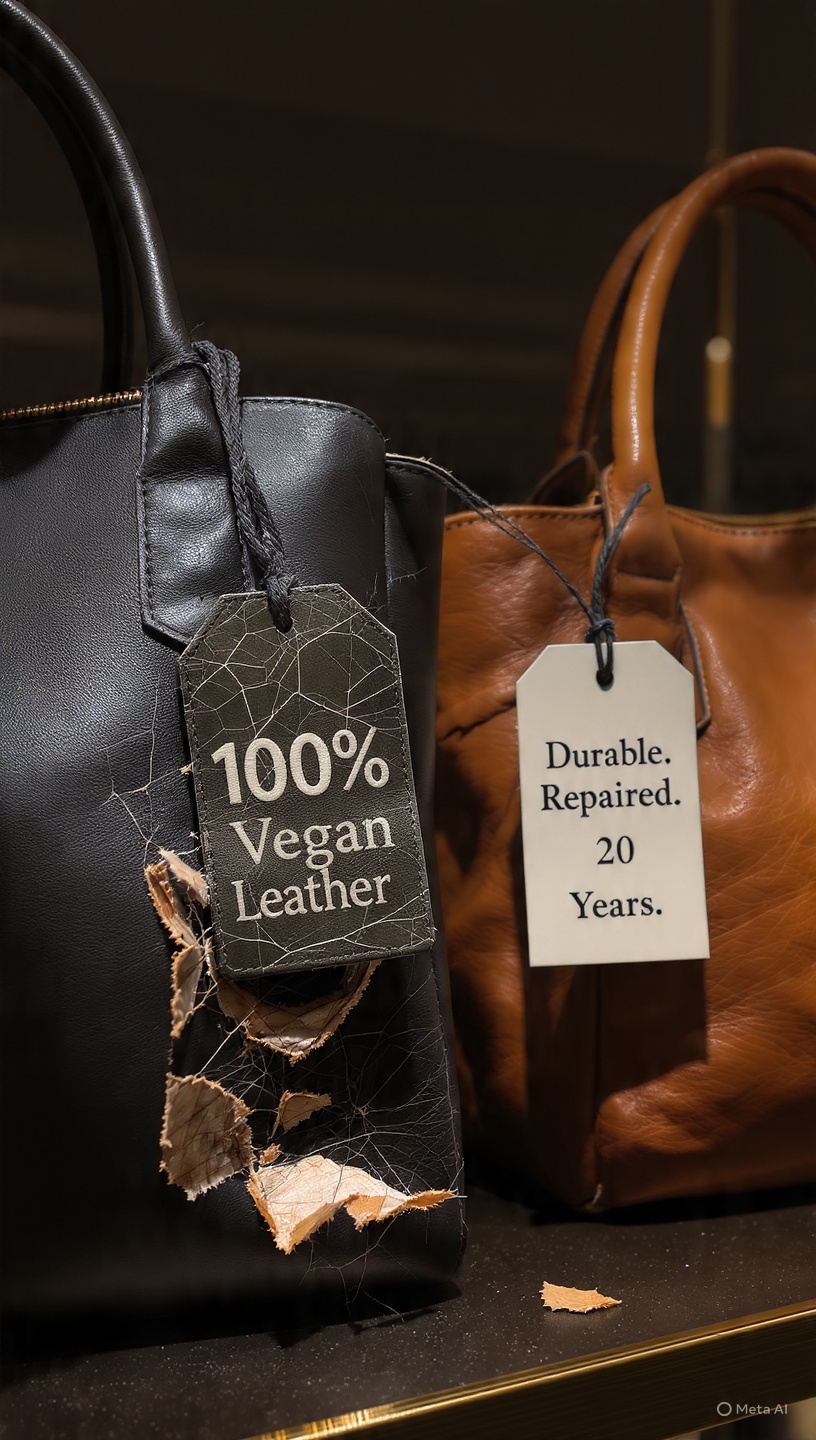
A wave of April 2026 reports is forcing brands to reckon with an uncomfortable truth: most “vegan leather” is plastic that cracks in three years. As consumers demand proof of lifespan, durability is replacing ingredients as fashion’s new sustainability metric.
For a decade, “vegan leather” was the easy win. It let brands sidestep animal cruelty, appeal to Gen Z, and print “sustainable” on a hangtag without changing much else. This April, that win expired.
A series of reports circulating during Earth Month — amplified by DC Climate Week panels and Arizona Eco Fashion Week programming — are crystallising a market-wide reversal: “vegan” is no longer shorthand for “sustainable.” In many cases, it’s the opposite.
The problem is plastic. Most commercial vegan leathers are polyurethane (PU) or polyvinyl chloride (PVC) bonded to a textile backing. They look like leather, feel like leather, and break down like a Ziploc bag left in the sun. Industry testing and resale data now show many begin cracking, peeling, or delaminating within 2-4 years of regular use.
“Vegan leather doesn’t necessarily equate to sustainable leather,” noted a Medium report on eco-friendly brands this month, echoing a sentiment now common across sourcing forums. “Sustainability is best measured by years of use, not by words on a tag.”
The Durability Data Brands Can’t Ignore
The timing matters. The sustainable fashion market hit $6.5 billion in 2026 and is projected to reach $15 billion by 2030. That growth is being driven by consumers fatigued by greenwashing. The average person now buys 53 items a year and wears each only 7-10 times. “Deinfluencing” content is up 158% since 2024.
In that context, a material that fails after 30 wears is a liability, regardless of what it’s made from. Repair services are growing 16% year-on-year. Resale platforms now grade bags and shoes partly on material longevity. A cracked PU tote has no second life. A 10-year-old leather briefcase does.
“Sustainability means something that is sustainably produced and will be sustained in your wardrobe for years,” said one sourcing director at a contemporary brand who asked not to be named due to ongoing vendor contracts. “If I have to relabel it ‘plant-based plastic’ to be honest, I’ve lost the customer anyway.”
The Fallout: From Hangtags to P&L
The backlash is hitting three places at once:
Marketing copy. Brands are quietly dropping “sustainable vegan leather” from e-commerce. It’s being replaced with “animal-free” or material-specific callouts like “PU-coated textile” with expected lifespan data. Transparency is the new defense against greenwashing claims.
Material investment. Money is moving. Stella McCartney, long the matriarch of eco-luxury, is doubling down on mycelium — mushroom leather — and plant-based feathers while debuting bio-engineered textiles like air-purifying “Pure.Tech” denim for S/S 2026. The bet: performance + biology beats petrochemicals.
The broader cellulose fiber market — cotton, hemp, flax, lyocell — was worth $40.1B in 2025 and is projected to reach $62B by 2035, partly because new recycling tech can finally separate blended fabrics for reuse. Biodegradability alone isn’t enough. Recoverability is.
Corporate finance. H&M and EY’s April whitepaper explicitly frames supply chain decarbonisation as financial risk reduction for CFOs. A product that creates waste in three years is a future take-back cost, a warranty claim, or a brand risk. Durability reduces all three.
What Counts as “Sustainable Leather” Now?
The industry is splintering into four camps, and April’s events are drawing the lines:
Camp 1: Bio-based, Durable. Mycelium, cactus, pineapple fiber, and lab-grown collagen. High cost, but multi-year lifespans and end-of-life pathways. This is where luxury and VC money is going.
Camp 2: Recycled Synthetics, Warrantied. PU made from recycled bottles, but sold with repair programs and 5-year guarantees. The argument: if you can keep it in use, the footprint amortizes.
Camp 3: Traceable Animal Leather. A counter-trend gaining quiet traction: vegetable-tanned, regenerative agriculture leather with lifetime repair. The pitch is “natural, durable, and circular if you actually use it for 20 years.”
Camp 4: No Leather At All. Brands like Sézane are leaning into canvas, woven textiles, and wood, avoiding the debate entirely by changing the silhouette.
The New Question Buyers Ask
DC Climate Week’s April 21 panel, “Fashion and the Climate Crisis: Policy and Innovation for a Cleaner Industry,” will feature local designers alongside tech innovators. The question on the agenda isn’t “Is it vegan?” It’s “How long will it last, and who fixes it when it breaks?”
That’s the same question behind Visa’s €110,000 Recycle the Runway fund and Arizona Eco Fashion Week’s April 19 community clothing swap. The system is rewiring to reward years of use, not units sold.
For designers, the hangover is real. Brands that built 2023-2025 capsule collections around “vegan leather” accessories are now stuck explaining why a $300 tote is peeling. The smart ones are launching repair kits. The smarter ones are quietly changing the bill of materials for 2027.
The Kicker
“Vogue Business” reported this month that even natural fibers can persist in some environments similar to synthetics. Biodegradation is conditional. The only metric that holds up across landfill, closet, and resale app is time.
So the new definition is simple, and brutal: If it can’t be worn, resold, or repaired in 2029, it wasn’t sustainable in 2026.
She merges scientific inquiry with traditional textile design, crafting innovative materials like bio-plastics. Grounded in biology and inspired by her heritage, her creations redefine clothing as vessels for storytelling, emotional resonance, and sustainability – garments that whisper their message and dissolve harmlessly into the environment.
Brenda Palomino is a bio-textile designer and founder of ‘Middle Child’ who creates sustainable, innovative materials by merging biology, materials science, and textile design, often using living organisms, microorganisms, or natural structural principles.
Palomino is Peruvian-born but currently based in the Pacific Northwest (PNW), a geographic region in western North America.
Her process is a fascinating blend of traditional and modern techniques. She starts by collecting and processing organic materials like seaweed, coffee grounds, and orange peels, breaking them down into biopolymers through fermentation or chemical treatment. These biopolymers are then mixed with natural additives to boost strength and texture, before being cast or molded into textile forms – think fabric or leather-like materials.
The final touch involves treating and finishing the materials to enhance durability and aesthetics. It’s a truly innovative approach that combines Peruvian heritage with cutting-edge science.
Brenda Palomino
Q & A
Why did you choose to work with this type of materials?
I work with seaweed and natural textiles to create materials that exist at the intersection of fashion, sculpture, and research. I grew up in Talara, where the coast basically eats everything. Between the salt, the sun, and the wind, nothing stays untouched, so I never really bought into the myth of “forever.”
My background is this weird collision between Biology and Fashion Design, and that duality drives my choices. When I look at synthetic textiles, I just see “forced immortality”: stuff that lasts but never resolves. I chose organic waste because it lets me design the exit as much as the entrance. Honestly, it’s also about rejecting scarcity.
Kelp and sea moss are everywhere; they’re cheap, they grow fast, and they don’t need fresh water or land. I’m not interested in a supply chain that bleeds the planet. I’d rather use what’s already here to engineer a timeline where fading is actually a function. I want the material to have the dignity of returning to the soil.
What’s your design inspiration?
My inspiration moves between natural patterns, architecture, and history. Nature gives me logic: repetition, erosion, membranes, and the way water layers over sand. Architecture inspired some of my silhouettes: a structure that can feel protective, sharp, or sensual depending on proportion.
History is my research tool. Looking back helps me understand what we inherit and repeat, allowing me to answer the present with intention. And Talara is always there in the background: ocean next to industry, beauty next to extraction. I love the idea of contrast as a permanent state.
What are the challenges of developing the bio-textile materials?
The main challenge is making a living material wearable without forcing it to behave like plastic. Biomaterials are sensitive to variables that industrial fashion tries to erase: humidity, temperature, drying speed, thickness, binder ratios, and pigment load. A small shift can change everything. I treat my studio like a lab: it is a constant trial and error. I’m documenting binder ratios and tear strength, but mostly I’m waiting for the material to tell me what it wants to do.
The hard part is balancing the science with the chaos. You have to accept that you’re collaborating with nature, not just commanding a surface. It’s a slow, sometimes frustrating negotiation, but that slowness is part of the integrity. You’re not manufacturing fabric; you’re engineering a material system.
Who are you designing for?
I design for people excited to feel and see something new, viewing clothing as a form of art and intellectual communication. They aren’t just looking for something ‘pretty’; they want a garment that carries weight and meaning.
I want the garment to create a sensory reaction: something unfamiliar, alive, slightly unsettling in the best way. I’m especially drawn to transparencies for anyone, regardless of gender, because sensuality isn’t a category; it’s already present in our bodies. I’m interested in highlighting that through light, movement, and surface.
The person I design for is comfortable with transparency and imperfection. They are comfortable with revealing without explaining. They’re willing to wear a piece of art that is slowly, beautifully dying. The person I design for values craft, experimentation, and clothing that carries meaning, not just trend.
As the fashion world shifts towards sustainability, Palomino’s pioneering work serves as a beacon, illuminating a path towards a more eco-friendly future. By merging ancient traditions with cutting-edge science, she’s crafting materials that not only reduce waste and pollution but also challenge our relationship with clothing itself.
Her creations invite us to rethink the lifecycle of fashion, from production to disposal, and envision a world where garments gently disappear, leaving behind only memories. In a industry often criticized for its environmental footprint, Palomino’s work is a powerful reminder that fashion can be both beautiful and sustainable, paving the way for a greener tomorrow.
NOTES:
Biopolymers are sustainable, biodegradable, and biocompatible polymers produced by living organisms (natural) or derived from renewable biological resources (bio-based).
Seaweed is a common name for large, multicellular marine algae, not true plants, that thrive in oceans and other water bodies, serving vital ecosystem roles and used globally as food (sushi, soups), fertilizer, cosmetics, and medicine, noted for being rich in iodine and other minerals, and coming in red, brown (kelp), and green varieties.
Seaweed is highly sustainable, acting as a regenerative, “zero-input” crop that requires no land, freshwater, pesticides, or fertilizers to grow. It functions as a powerful, fast-growing carbon sink—sequestering carbon 50 times faster than terrestrial plants—while reducing ocean acidification and providing habitat for marine life.