Kampala artisans turn byproduct into pieces rooted in Ugandan heritage.
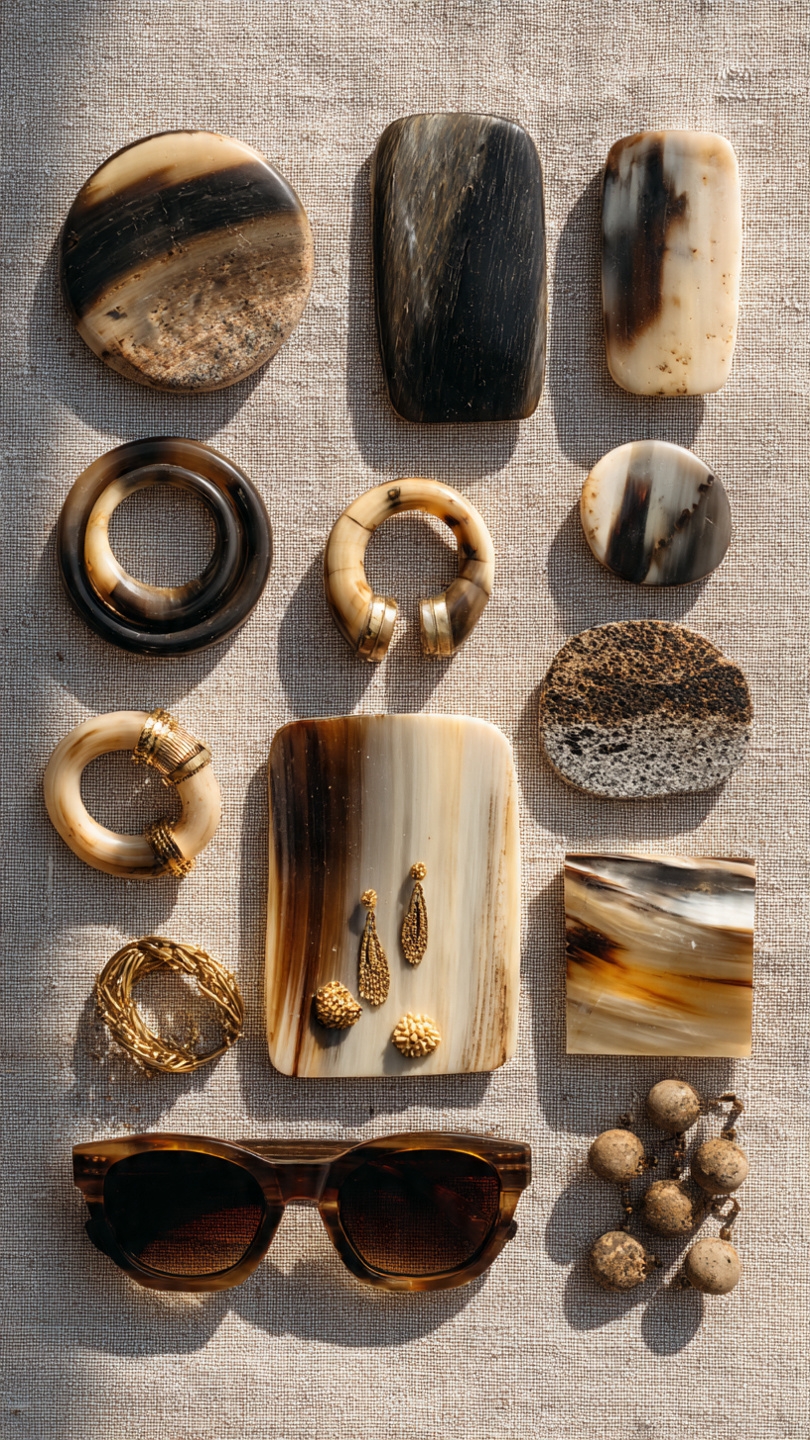
In a small workshop in Kampala, founder Sandra Kekirunga turns Ankole cow horn into statement jewellery. Ihato is a Ugandan accessories brand working with horn, reclaimed brass, paper beads, and banana fiber. The brand focuses on bold cuffs, layered necklaces, and bangles carved by hand.
No molds, no mass production. Just heat, skill, and material that already existed. Ihato works with repurposed material in a craft tradition common in East Africa.
From Pasture to Product
Ihato uses Ankole cow horn. Ankole cattle, native to Western Uganda, are known for their large, curved horns. The horns come from cattle already slaughtered for meat and dairy.
In Ihato’s workshop, the horns are cleaned, boiled, cut, and flattened with heat and pressure. No harsh chemicals. Once cooled, the horn holds its shape. The marbling shifts from deep brown to black to amber, so no two bangles or earrings are identical. That variation comes from the material itself.
Horn is paired with reclaimed brass from Kampala’s metal markets, hand-rolled paper beads, and banana fiber. Materials are sourced locally and processed by hand.
Heritage in Form
The designs reference Ugandan adornment traditions. Wide cuffs and layered beads echo styles seen across Western Uganda. The pieces are made for daily wear – office, gallery, wedding, or everyday.
Sustainable by Design
Ihato operates as a low-energy, artisanal workshop. Human craftsmanship replaces machines. The materials are upcycled byproducts, so the environmental cost is collection and craft, not extraction.
For decades it was written off as rustic, replaced by plastic and resin. Now cow horn is slipping back into fashion’s vocabulary. It comes from a natural byproduct, carries unique marbling in every piece, and ages better than anything synthetic.
From buttons that ground a coat to sunglasses that catch light like tortoiseshell, designers are choosing it again for its strength, texture, and zero-waste story. It’s not a trend chasing attention. It’s a material remembering its value. After years of uniformity, fashion is circling back to something real. Cow horn isn’t new. It’s just back.
What cow horn actually is
Cow horn is a byproduct of the meat and dairy industry. It grows like fingernails, and it’s harvested after slaughter. No one’s raising cows just for their horns.
Once separated, the horn is cleaned, cut, and shaped using heat and pressure. No harsh chemicals are needed. When heated, horn becomes pliable. Cool it down and it holds the shape permanently.
The result is a material that looks like tortoiseshell or amber, but with natural marbling that’s impossible to fake. No two pieces are identical.
Why it disappeared, and why it matters now
Plastic killed horn for the same reason it killed most natural materials: scale. Injection molding is fast. Horn needs heat, hand-finishing, and skill.
But scale is exactly what got us into 92 million tons of textile waste a year. And plastic’s other problem is longevity. It’s durable in the wrong way — it sits in landfills for centuries.
Horn is different. It’s biodegradable. It’s strong. It ages well. A horn button on a coat won’t fall apart after 10 washes. A horn comb won’t melt if you leave it in a hot car.
Where it shows up today
You’ll find cow horn mostly in places where small details matter: buttons on coats, eyewear frames, combs, hair accessories, jewelry, knife handles, home goods.
It’s not trying to compete with polyester on price. It’s competing on lifespan. The pitch is simple: buy it once, keep it 20 years. That’s a harder sell on Instagram, but it’s what “sustainable” actually looks like in practice.
The bigger point
Materials like cow horn force a different question. Not “how cheap can we make this?” but “how long should this last?”
Fashion’s been addicted to newness for so long that we forgot materials had a second life before landfills. Horn, horn-like alternatives from buffalo water buffalo, and other animal byproducts are a reminder that waste streams already exist. The problem is we’ve designed systems that ignore them.
If you care about cutting fashion’s environmental footprint, the boring stuff matters more than the buzzwords. Collection, craft, and materials that don’t turn to trash in 2 years.
Bottom line: Cow horn won’t fix overproduction. But it’s a small example of what happens when you design for longevity instead of turnover. And in a market drowning in stuff, that’s a radical idea.
Day after day, 2.5 billion cups of coffee turn into 6 million tons of waste. Most of it gets bagged, trucked, buried. In landfills, it rots and leaks methane.
Fifteen years ago, a Taiwanese textile engineer looked at that pile and didn’t see trash. He saw a problem he could fix — and a fiber he could make. That’s how S.Café started.
An accident that made sense
S.Café is an innovative, eco-friendly textile technology created by the Taiwanese company Singtex. It transforms recycled coffee grounds into high-performance, sustainable yarns and fabrics used in activewear, outdoor clothing, and footwear linings.
Singtex wasn’t trying to win sustainability awards. They were trying to make better polyester. In 2008, they began experimenting with grinding coffee grounds into nano-sized particles and blending them directly into the thread during manufacturing. The idea sounded gimmicky. But when they tested it, the fabric did things regular polyester couldn’t.
The coffee wasn’t a marketing line. It was the active ingredient.
Because the grounds are embedded into the yarn itself, the fabric naturally inherits long-lasting performance properties that don’t wash out. The microscopic pores trap and neutralise body odor. The structure pulls moisture away from the skin and spreads it across the surface, drying up to 200% faster than cotton. The unique composition even helps reflect harmful UVA and UVB rays. You don’t coat the fabric afterward. You build the function in.
From waste bin to running tee
The process starts in cafes and offices. Used grounds are collected, dried, and ground until they’re finer than talc. Those nano-particles get mixed into polyester or nylon chips. Heat, pressure, extrusion — and out comes a fiber that looks and feels like regular synthetic, but behaves differently.
The natural shade is coffee-brown. If brands want colour, S.Café uses dope-dyeing. That injects pigment during extrusion and cuts water use by up to 80% compared to conventional dyeing.
Coffee makes up only 5-8% of the fiber by weight. The rest is still polyester or nylon. So it’s not a solution to microplastic shedding. But it’s a way to make synthetic perform better while diverting waste.
And the process doesn’t stop at fabric. The coffee oil extracted during production is repurposed into eco-friendly cosmetics and bio-materials, so almost nothing goes to waste.
You’ve probably worn it already
S.Café never chased the hangtag. It stayed B2B, showing up inside other brands’ collections. In 2025, Puma ran S.Café in its running tees and shorts, marketing them for odor control and quick dry. Timberland used it for workwear and hiking gear that needed to stay dry and tough. Under Armour and The North Face put it in base layers for “all-day freshness.” Uniqlo even used it in past AIRism blends for cooling.
It’s quiet. No logos. No coffee leaf graphics. Just fabric that works.
Why it survived when others didn’t
The graveyard of eco-materials is full of ideas that looked good in a press release and fell apart in the wash. Mushroom leather that peeled. Pineapple fiber that couldn’t scale. Bamboo blends that pilled after two washes.
S.Café stuck because it solved a real problem. Sweat smells. Polyester traps it. Athletes hate that. Coffee grounds fix it, cheaply and permanently.That’s what materials people call “functional upcycling.” The waste isn’t reused to make you feel virtuous. It’s reused because it has properties you’d otherwise have to engineer with chemicals.
Fifteen years later, Singtex is still supplying it. That’s the test.What to look for next time you shopFlip the tag on your next performance tee or base layer. If you see “coffee fiber,” “S.Café,” or “Singtex,” you know what you’re getting: a fabric that dries faster, smells less, and blocks UV without chemical finishes.It’s not the future of all clothing.
Cotton, hemp, and regenerated fibers still carry everyday wear. But for performance gear, S.Café is proof that waste isn’t the end of the line. Sometimes it’s the beginning. And if you’re drinking coffee while reading this, well — you’re part of the supply chain.
How a craftswoman in Nakhon Ratchasima turns landfill-bound fabric into wearable memory
In a small home in Nakhon Ratchasima, Thailand, she sits with needle, thread, and the leftovers of the world. Cotton dyed with indigo. Hemp stained by ebony fruit. Scraps of linen a factory meant to discard. In her hands, none of it stays waste. It becomes something joyful. Something wearable. Something new.
Dao Ann Craft, founded by Darawan “Dao” Phukamkom, is not a fashion brand in the conventional sense, but a practice of repair, memory, and slow making. Dao is a craftswoman. Every piece that leaves her home is handmade, stitched without the hurry of machines. She calls it slow stitching, but the philosophy runs deeper than pace. It’s about presence. The hand must be in the work. The maker must be accountable to the material.
Her studio is built on natural fibers and plant dyes, yet the heart of it lies in the textiles she sources from second-hand markets across Thailand and beyond. Vintage hemp fabrics. Naga tribal cloth. Teen jok textiles from Laos. Remnants of kimono silk and Japanese cotton. These are fabrics no longer in production — rare fragments of cultural history, each carrying its own story and patina of time. Dao doesn’t see them as relics. She sees them as beginnings.
From these fragments come garments, bags, brooches, bracelets bound with spring wire. Nothing is too small to save. A fragment of indigo-dyed cotton becomes the center of a jacket panel. An offcut of tribal weave becomes the lining of a tote, hidden until the owner discovers it. The patchwork isn’t decoration. It’s cartography — a map of where each textile has been, and where Dao is determined it will go next.
The turning point came when she found a linen printing factory outside the city. Rolls of overproduced fabric, misprints, and imperfect textiles were slated for disposal. The volume was staggering. The waste, unnecessary. “To reduce waste, I chose to give these fabrics a new life,” Dao explains. That decision redefined her practice. What was industrial excess became her raw material. What was destined for landfill became limited-edition art.
But Dao’s work doesn’t end at her stitching table. Twice a year, she opens her home and her practice to others. She organises a small community for people who are drawn to fabric scraps — not to teach patterns or perfection, but to share the experience of working with leftovers. In each session, the focus is freedom, not formulas. “There is no right or wrong in what we create, because it is art,” she says. “I truly believe that everyone has their own unique creativity.”
On those days, the studio shifts. It becomes a circle, not a workshop. Scraps spill across the table. Stories spill with them. A retired teacher patches memory into cloth. A student learns that a crooked seam still holds. Nobody graduates. Nobody fails. They just make. And in making together, the waste shrinks and the lineage grows.
Dao Ann Craft now moves between scales. Some days, she’s stitching a single brooch from scraps no larger than a palm. Other days, she’s composing large textile art pieces for exhibition — works that hang on gallery walls but carry the same logic as her clothing: every seam is intentional, every fabric has a past.
There is no collection drop. No seasonal calendar. There is only the rhythm of the material and the maker. When the right scrap appears, the work begins. When the stitching is done, the piece is released. Each one is one-of-a-kind, impossible to replicate because the source material itself cannot be repeated.
In an industry loud with promises of sustainability, Dao Ann Craft is quiet. There are no buzzwords here. No marketing decks about circularity. Just a woman in Nakhon Ratchasima who looked at what the world was throwing away — fabric, history, beauty — and decided to pick up a needle. Then handed one to someone else.
Banana pseudostems — the trunks left after fruit harvest — are moving into commercial fiber supply. What was once field waste is now being processed into a standardised raw material for textiles, paper, and bio-composites, with mills in Brazil leading early industrial adoption.
Circularity studies of banana farming show that only a fraction of the plant is edible. The remainder is biomass, with residue in some systems reaching ∼220 tons per hectare. Producer countries like Brazil generate tens of millions of tons of pseudostem waste annually. That volume is driving interest from textile and nonwoven manufacturers looking for non-wood cellulosic inputs.
The draw is performance. Banana pseudostem fiber has a high cellulose content and tensile strength that lab tests place around 570 MPa for mechanically extracted fiber — above jute and sisal. That positions it for yarns, blended fabrics, and reinforcement materials where strength-to-weight matters.
From Craft to Contract
Banana fiber has existed in artisan markets for years. The shift now is supply-chain formalisation: quality grades, traceability, and safety protocols that match cotton, flax, and hemp systems.
In Brazil, FIESC has spotlighted work at the SENAI Institute of Textile Technology, Apparel and Design developing banana-stem fabrics for large-scale use. One project, Banana Têxtil, took a woven made from banana stalks to the finals of the BRICS Solutions Awards, signaling readiness for industrial weaving beyond craft.
Inside the Fiber Plant
Processing starts near farms. Pseudostems are up to 90% water, making long-haul transport unviable. On arrival, stems are graded by size, moisture, and condition. Degraded material yields shorter, higher-impurity fiber and is routed accordingly.
Extraction is mechanical. In decortication, rollers and blades press and scrape the pseudostem to separate fiber from wet pulp. Technical studies flag this route as the most scalable for industry because it avoids harsh chemicals and produces spinnable fiber.
Washing follows immediately to remove non-fibrous residue and odour, and to improve hand feel. Water use is the key environmental variable here. Leading plants run closed-loop recirculation and on-site treatment to control cost and impact.
Drying is treated as process control, not passive evaporation. Plants combine ventilated air drying with temperature-controlled ovens to prevent mold and stabilize color. Research shows drying temperature directly affects fiber’s physical and mechanical properties, so consistency is critical for downstream spinning.
Opened and aligned using equipment common to other bast fibers, the material is then ready for spinning, nonwovens, or composite reinforcement. Quality control tracks average length, moisture, impurity levels, and strength parameters. For mills, the requirement is simple: batch-to-batch consistency.
Where It Goes
Textiles are the primary driver. Brazilian and international projects are already spinning banana-blended yarns and weaving fabrics for apparel and home textiles, typically mixed with cotton or synthetics to balance hand, cost, and performance.
Paper and packaging are secondary outlets moving past lab scale. A recent open-access study tested thermomechanically-extracted pseudostem fiber blended with gum arabic to mold fruit packaging boards. The boards matched or outperformed recycled paper pulp trays in mechanical tests, though water absorption was higher.
Closing the Loop
Fiber is only part of the mass balance. The pulp and sap from decortication can be composted, digested for biogas, or processed into liquid organic fertiliser. Trials using pseudostem-based inputs with microbial mixes show nutrient return to farms, reducing synthetic fertiliser dependence.
For the plant, financial and environmental viability depends on utilising the full biomass stream. Without off-take for pulp and sap, operators face disposal costs and local communities face odour and runoff risk.
The Takeaway for Mills
Banana fiber is entering the market as a spec-driven input, not a novelty. Strength, local availability in producer regions, and chemical-light processing are the pitch. Water management in washing and energy control in drying are the constraints. Consistency will decide if it stays in blends or moves to higher percentages in mainstream fabric.
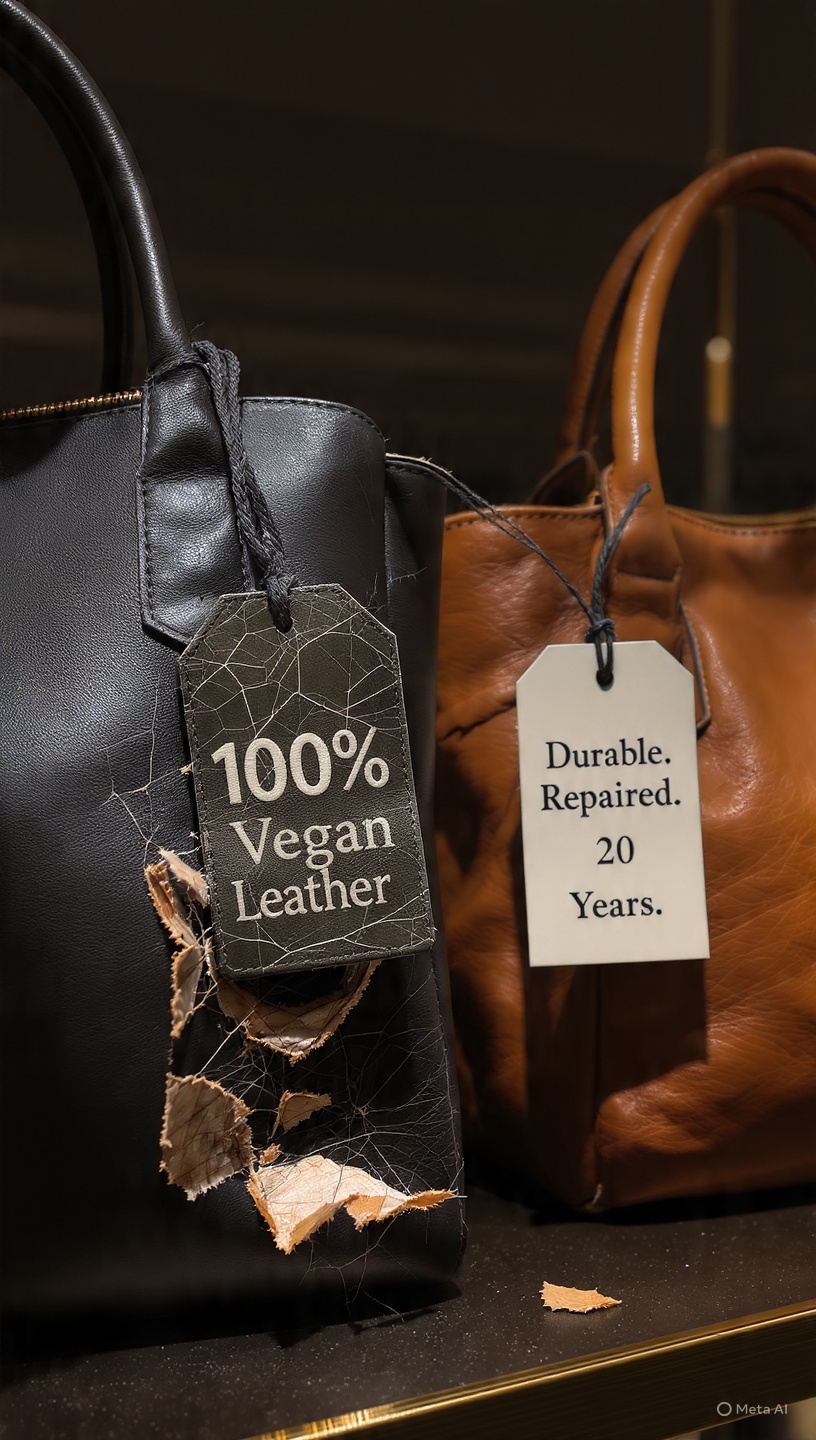
A wave of April 2026 reports is forcing brands to reckon with an uncomfortable truth: most “vegan leather” is plastic that cracks in three years. As consumers demand proof of lifespan, durability is replacing ingredients as fashion’s new sustainability metric.
For a decade, “vegan leather” was the easy win. It let brands sidestep animal cruelty, appeal to Gen Z, and print “sustainable” on a hangtag without changing much else. This April, that win expired.
A series of reports circulating during Earth Month — amplified by DC Climate Week panels and Arizona Eco Fashion Week programming — are crystallising a market-wide reversal: “vegan” is no longer shorthand for “sustainable.” In many cases, it’s the opposite.
The problem is plastic. Most commercial vegan leathers are polyurethane (PU) or polyvinyl chloride (PVC) bonded to a textile backing. They look like leather, feel like leather, and break down like a Ziploc bag left in the sun. Industry testing and resale data now show many begin cracking, peeling, or delaminating within 2-4 years of regular use.
“Vegan leather doesn’t necessarily equate to sustainable leather,” noted a Medium report on eco-friendly brands this month, echoing a sentiment now common across sourcing forums. “Sustainability is best measured by years of use, not by words on a tag.”
The Durability Data Brands Can’t Ignore
The timing matters. The sustainable fashion market hit $6.5 billion in 2026 and is projected to reach $15 billion by 2030. That growth is being driven by consumers fatigued by greenwashing. The average person now buys 53 items a year and wears each only 7-10 times. “Deinfluencing” content is up 158% since 2024.
In that context, a material that fails after 30 wears is a liability, regardless of what it’s made from. Repair services are growing 16% year-on-year. Resale platforms now grade bags and shoes partly on material longevity. A cracked PU tote has no second life. A 10-year-old leather briefcase does.
“Sustainability means something that is sustainably produced and will be sustained in your wardrobe for years,” said one sourcing director at a contemporary brand who asked not to be named due to ongoing vendor contracts. “If I have to relabel it ‘plant-based plastic’ to be honest, I’ve lost the customer anyway.”
The Fallout: From Hangtags to P&L
The backlash is hitting three places at once:
Marketing copy. Brands are quietly dropping “sustainable vegan leather” from e-commerce. It’s being replaced with “animal-free” or material-specific callouts like “PU-coated textile” with expected lifespan data. Transparency is the new defense against greenwashing claims.
Material investment. Money is moving. Stella McCartney, long the matriarch of eco-luxury, is doubling down on mycelium — mushroom leather — and plant-based feathers while debuting bio-engineered textiles like air-purifying “Pure.Tech” denim for S/S 2026. The bet: performance + biology beats petrochemicals.
The broader cellulose fiber market — cotton, hemp, flax, lyocell — was worth $40.1B in 2025 and is projected to reach $62B by 2035, partly because new recycling tech can finally separate blended fabrics for reuse. Biodegradability alone isn’t enough. Recoverability is.
Corporate finance. H&M and EY’s April whitepaper explicitly frames supply chain decarbonisation as financial risk reduction for CFOs. A product that creates waste in three years is a future take-back cost, a warranty claim, or a brand risk. Durability reduces all three.
What Counts as “Sustainable Leather” Now?
The industry is splintering into four camps, and April’s events are drawing the lines:
Camp 1: Bio-based, Durable. Mycelium, cactus, pineapple fiber, and lab-grown collagen. High cost, but multi-year lifespans and end-of-life pathways. This is where luxury and VC money is going.
Camp 2: Recycled Synthetics, Warrantied. PU made from recycled bottles, but sold with repair programs and 5-year guarantees. The argument: if you can keep it in use, the footprint amortizes.
Camp 3: Traceable Animal Leather. A counter-trend gaining quiet traction: vegetable-tanned, regenerative agriculture leather with lifetime repair. The pitch is “natural, durable, and circular if you actually use it for 20 years.”
Camp 4: No Leather At All. Brands like Sézane are leaning into canvas, woven textiles, and wood, avoiding the debate entirely by changing the silhouette.
The New Question Buyers Ask
DC Climate Week’s April 21 panel, “Fashion and the Climate Crisis: Policy and Innovation for a Cleaner Industry,” will feature local designers alongside tech innovators. The question on the agenda isn’t “Is it vegan?” It’s “How long will it last, and who fixes it when it breaks?”
That’s the same question behind Visa’s €110,000 Recycle the Runway fund and Arizona Eco Fashion Week’s April 19 community clothing swap. The system is rewiring to reward years of use, not units sold.
For designers, the hangover is real. Brands that built 2023-2025 capsule collections around “vegan leather” accessories are now stuck explaining why a $300 tote is peeling. The smart ones are launching repair kits. The smarter ones are quietly changing the bill of materials for 2027.
The Kicker
“Vogue Business” reported this month that even natural fibers can persist in some environments similar to synthetics. Biodegradation is conditional. The only metric that holds up across landfill, closet, and resale app is time.
So the new definition is simple, and brutal: If it can’t be worn, resold, or repaired in 2029, it wasn’t sustainable in 2026.