Program targets circularity, biodiversity, sourcing, and climate for employees across functions.
Christian Dior Couture has partnered with the Institut Français de la Mode to launch a sustainability training initiative for employees worldwide. The Sustainability Fashion Leadership Program was unveiled in late May.
The program is part of Dior’s “Dream in Green” strategy and aligns with LVMH’s Life 360 environmental roadmap. Goal: embed sustainability across all business functions and translate environmental commitments into practical action.
Program Structure
Dior said the training will give employees access to sustainability-focused conferences and educational content developed with IFM, the French fashion and luxury education institution. Topics span design, merchandising, logistics, finance, legal, and supply chain operations.
A certified one-year training track has been created for a first cohort of 23 employees drawn from more than 15 departments. The curriculum is structured around four modules covering regulation, responsible sourcing and manufacturing, traceability, biodiversity, eco-design, circularity, climate, and sustainable performance. Participants will also receive coaching to develop projects for internal implementation.
Leadership Perspective
Clément Lefevre, chief sustainability officer at Christian Dior Couture, stated: “With ‘Dream in Green,’ we aim to train all our employees so that everyone can have a positive impact within their position. This training program, developed in collaboration with IFM, is thus designed as a driver for action, allowing teams to translate the house’s vision into concrete, innovative and meaningful initiatives.”
Madrid summit brings 250 textile and apparel leaders together to confront compliance, data gaps, and textile waste.
The Move! Sustainability Fashion Summit 2026 took place recently in Madrid, Spain, gathering approximately 250 professionals from across the textile, apparel, and footwear value chain. Discussions focused on circular systems, textile waste, business resilience, and the operational realities of sustainability.
Key Takeaways
Sustainability is now compliance, not choice
Across sessions, a clear shift emerged: sustainability is moving from strategic differentiator to business requirement. Evolving regulations are pushing companies to treat it as a baseline for operation, not a marketing edge.
Data and infrastructure remain bottlenecks
Fragmented data systems and limited infrastructure continue to slow progress toward circularity. Speakers pointed to ongoing challenges with traceability and harmonized measurement as major barriers to scale.
Collaboration is non-negotiable Industry leaders emphasized that addressing textile waste and scaling solutions will require coordination across the entire value chain. No single player can close the loop alone.
From Ambition to Operations
Speakers from H&M, the Ellen MacArthur Foundation, ReHubs, Pangaia, and the Regenerative Fund for Nature shared perspectives on circular business models, post-consumer textile waste, regenerative production, and the infrastructure needed for industry-wide transformation.
Several discussions highlighted the gap between circularity goals and current operations. While brands are investing in resale, collection, and recycling, challenges persist around traceability, data fragmentation, and limited recycling capacity. Industry experts noted that textile-to-textile recycling remains below 1% globally, underscoring the scale of work ahead.
Roundtable conversations also examined the link between sustainability investment and business performance. Participants noted that consumers continue to prioritise quality, design, and value, with sustainability increasingly expected as standard rather than a primary purchase driver.
The Road Ahead
The summit reinforced what many in the industry already know: progress depends on credible sustainability data, harmonized measurement tools, and deeper collaboration across suppliers, brands, and recyclers. With regulation tightening, the conversation is shifting from “why” to “how”.
Kampala artisans turn byproduct into pieces rooted in Ugandan heritage.
In a small workshop in Kampala, founder Sandra Kekirunga turns Ankole cow horn into statement jewellery. Ihato is a Ugandan accessories brand working with horn, reclaimed brass, paper beads, and banana fiber. The brand focuses on bold cuffs, layered necklaces, and bangles carved by hand.
No molds, no mass production. Just heat, skill, and material that already existed. Ihato works with repurposed material in a craft tradition common in East Africa.
From Pasture to Product
Ihato uses Ankole cow horn. Ankole cattle, native to Western Uganda, are known for their large, curved horns. The horns come from cattle already slaughtered for meat and dairy.
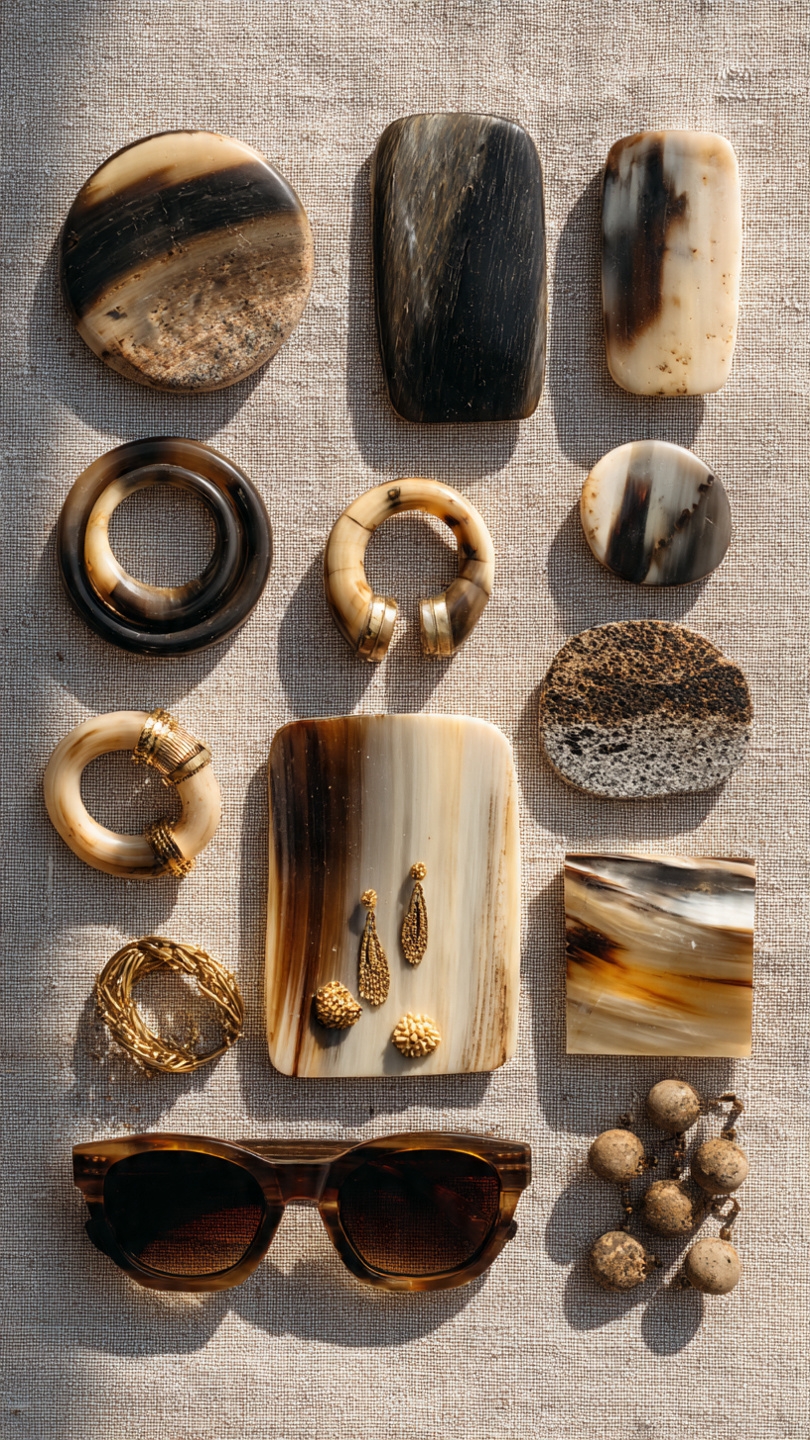
In Ihato’s workshop, the horns are cleaned, boiled, cut, and flattened with heat and pressure. No harsh chemicals. Once cooled, the horn holds its shape. The marbling shifts from deep brown to black to amber, so no two bangles or earrings are identical. That variation comes from the material itself.
Horn is paired with reclaimed brass from Kampala’s metal markets, hand-rolled paper beads, and banana fiber. Materials are sourced locally and processed by hand.
Heritage in Form
The designs reference Ugandan adornment traditions. Wide cuffs and layered beads echo styles seen across Western Uganda. The pieces are made for daily wear – office, gallery, wedding, or everyday.
Sustainable by Design
Ihato operates as a low-energy, artisanal workshop. Human craftsmanship replaces machines. The materials are upcycled byproducts, so the environmental cost is collection and craft, not extraction.
For decades it was written off as rustic, replaced by plastic and resin. Now cow horn is slipping back into fashion’s vocabulary. It comes from a natural byproduct, carries unique marbling in every piece, and ages better than anything synthetic.
From buttons that ground a coat to sunglasses that catch light like tortoiseshell, designers are choosing it again for its strength, texture, and zero-waste story. It’s not a trend chasing attention. It’s a material remembering its value. After years of uniformity, fashion is circling back to something real. Cow horn isn’t new. It’s just back.
What cow horn actually is
Cow horn is a byproduct of the meat and dairy industry. It grows like fingernails, and it’s harvested after slaughter. No one’s raising cows just for their horns.
Once separated, the horn is cleaned, cut, and shaped using heat and pressure. No harsh chemicals are needed. When heated, horn becomes pliable. Cool it down and it holds the shape permanently.
The result is a material that looks like tortoiseshell or amber, but with natural marbling that’s impossible to fake. No two pieces are identical.
Why it disappeared, and why it matters now
Plastic killed horn for the same reason it killed most natural materials: scale. Injection molding is fast. Horn needs heat, hand-finishing, and skill.
But scale is exactly what got us into 92 million tons of textile waste a year. And plastic’s other problem is longevity. It’s durable in the wrong way — it sits in landfills for centuries.
Horn is different. It’s biodegradable. It’s strong. It ages well. A horn button on a coat won’t fall apart after 10 washes. A horn comb won’t melt if you leave it in a hot car.
Where it shows up today
You’ll find cow horn mostly in places where small details matter: buttons on coats, eyewear frames, combs, hair accessories, jewelry, knife handles, home goods.
It’s not trying to compete with polyester on price. It’s competing on lifespan. The pitch is simple: buy it once, keep it 20 years. That’s a harder sell on Instagram, but it’s what “sustainable” actually looks like in practice.
The bigger point
Materials like cow horn force a different question. Not “how cheap can we make this?” but “how long should this last?”
Fashion’s been addicted to newness for so long that we forgot materials had a second life before landfills. Horn, horn-like alternatives from buffalo water buffalo, and other animal byproducts are a reminder that waste streams already exist. The problem is we’ve designed systems that ignore them.
If you care about cutting fashion’s environmental footprint, the boring stuff matters more than the buzzwords. Collection, craft, and materials that don’t turn to trash in 2 years.
Bottom line: Cow horn won’t fix overproduction. But it’s a small example of what happens when you design for longevity instead of turnover. And in a market drowning in stuff, that’s a radical idea.
Jeff Bezos and Lauren Sánchez have put $34 million behind a simple, stubborn problem: most of our clothes are made from oil.
Through the Bezos Earth Fund, the couple is funding the development of plastic-free, biodegradable textiles — alternatives to polyester and viscose that dominate fashion but pollute long after we’re done wearing them. Polyester is petroleum. Viscose is water-hungry and chemical-heavy. Both shed microplastics. Both were built for speed and scale, not for return to the earth.
So the money goes to labs at Columbia, UC Berkeley, and Clemson, where scientists are growing fibers from bacteria and spinning new life from agricultural waste. The goal isn’t a single miracle fabric. It’s a wardrobe of options that feel like silk or cotton, perform beautifully, and disappear without a trace.
This is a shift. The Earth Fund’s $10 billion climate pledge has, until now, flowed toward forests and conservation. Now it’s moving into the factory, because textiles drive up to 4% of global emissions — and the fiber is where that footprint starts.The challenge is familiar to any woman who’s tried to shop “better.”
These new materials are expensive. They’re not yet at scale. And the industry still reaches for polyester because it’s cheap, available, and stitched into every supply chain. Innovation exists. Adoption lags.There’s a quiet irony, too.
Bezos chairs Amazon, one of the world’s largest clothing sellers, a company facing its own questions about waste and overproduction. The Fund is independent, but the tension lingers: can new fibers fix fashion if we keep making at the same pace?Maybe not.
But materials matter. $34 million won’t reweave the industry overnight. But it’s a bet that the next story we wear might start not with oil, but with something that can return to the soil.