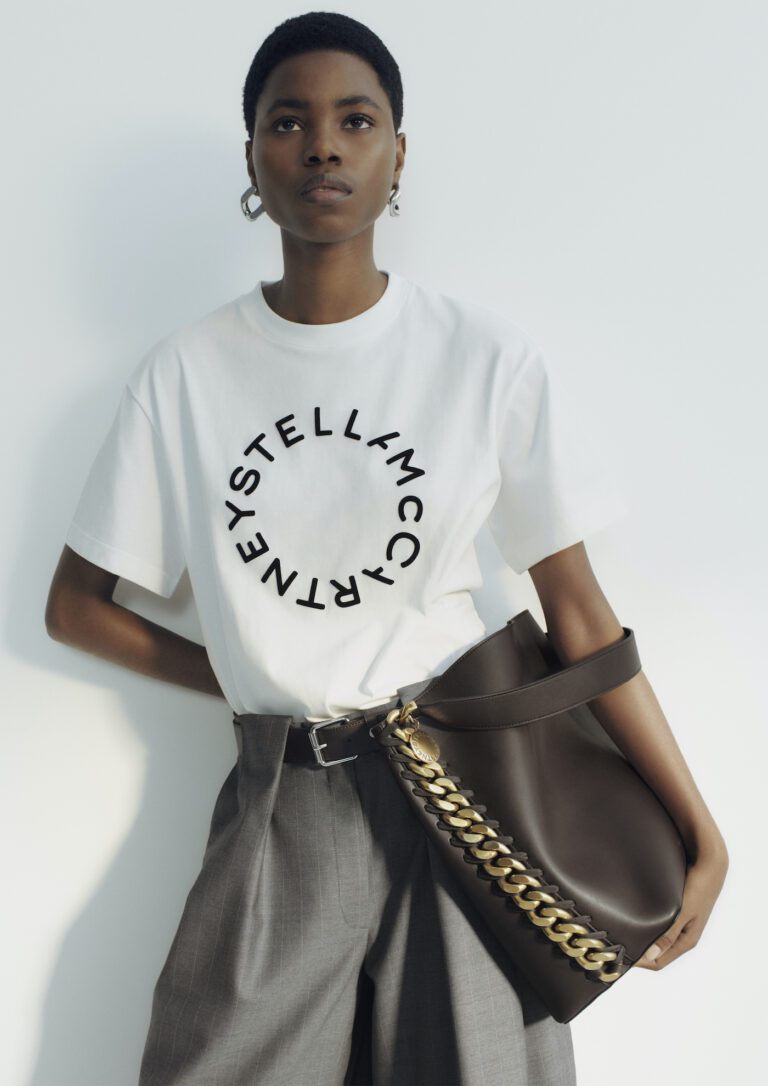
Stella McCartney returns to H&M in May with a sustainable capsule aimed at the high street, but the trade story is less about the “Rock Royalty” T-shirt (£37.99) and more about what happens when a luxury designer’s material standards hit a 3-billion-unit supply chain.
The collection includes oversized pinstripe tailoring — blazer (£259.99) and trousers (£139.99) — made from wool certified to Responsible Wool Standard (RWS). A comparable McCartney mainline set retails above £1,000. The price drop comes from H&M’s scale, not a standards drop, McCartney says: “This is not the cheapest of the cheap because there is a price that comes with doing anything good. But it’s an access area for more people.”
McCartney frames the capsule as “one for those that don’t know what sustainable means.” For the industry, it’s a test: Can a fast-fashion retailer integrate higher-spec inputs without reverting to lowest-cost substitution under margin pressure?


Ann-Sofie Johansson, H&M’s creative adviser, credits McCartney’s first 2005 collab for shifting H&M toward organic and recyclable cotton. “I also wanted to introduce them to my suppliers that champion sustainability,” McCartney said. “When H&M put in an order, it is meaningful, it can be life-changing for an innovator.”
“I hate how elitist the fashion industry is,” McCartney said. “I want a younger and wider audience to have access to my stuff.” For _Fabric and Garment_ readers, translate that: she’s using H&M’s order book to pull certified and next-gen materials into price brackets most consumers actually pay.


The collection drops in May. Twenty-one years after her first H&M sell-out, the metric to watch isn’t units moved. It’s whether the RWS, rPA, and bio-plastic specified here show up in H&M’s core lines 12 months later.