
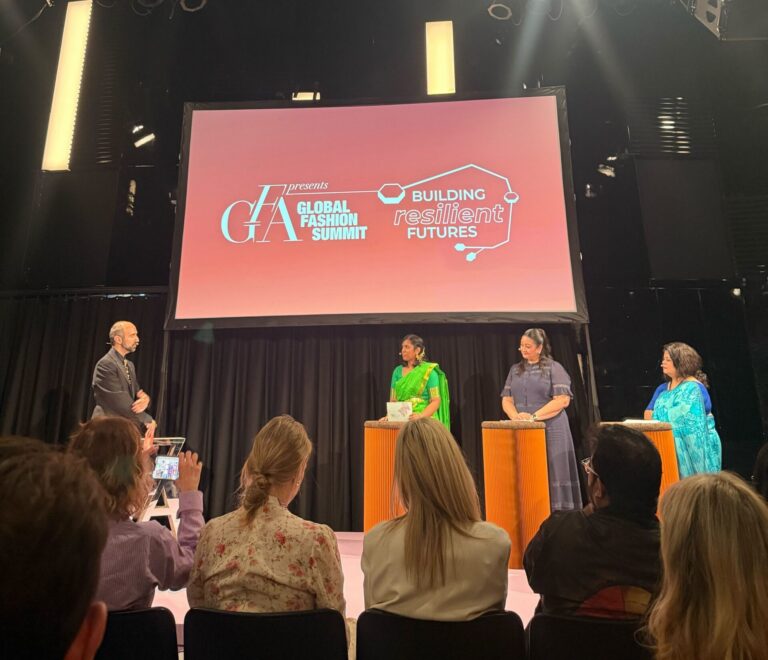
17th edition brings 140 speakers and global industry leaders together for three days of programming.
Global Fashion Agenda hosted its 17th annual Global Fashion Summit in Copenhagen earlier this month. Host Arizona Muse and CEO Federica Marchionni led programming that featured 140 speakers and hundreds of attendees from across the fashion value chain.
Finance and Risk Take Center Stage
Financing sustainability was a key theme. A session included H&M Group’s head of green investment Ulrika Leverenz, BESTSELLER’s head of sustainability Dorte Rye Olsen, Kering’s sustainable finance director Laurence Barrère, and Boston Consulting Group’s managing director Catharina Martinez-Pardo.
The discussion accompanied GFA’s “Fashion CFO Agenda 2026: Building Financial Resilience Through Sustainability” report produced with BCG. The report was among several GFA-authored releases during the week focused on impact measurement and policy.
Speakers emphasised deeper involvement from finance teams in sustainability. Olsen highlighted the need to integrate sustainability beyond dedicated ESG functions. Leverenz framed sustainability as enterprise risk management rather than a separate initiative.
Retail, Resilience, and Consumer Shifts
In a conversation between Marchionni and Chalhoub Group’s executive chairman Patrick Chalhoub, the focus turned to retail amid geopolitical shifts. Chalhoub noted: “The human being has this level of resilience and reinventing itself.” Cost-cutting, sourcing shifts, and supply chain efficiency were cited as ongoing lessons in an evolving business landscape.
Materials and Consumer Awareness
In “Redefining the Diamond,” Pandora’s marketing chief Jennifer Farmer and celebrity ambassador Pamela Anderson discussed “romantic activism” and consumer awareness. Anderson noted young consumers understand carbon footprinting. Farmer spoke to growth in lab-grown diamonds and their cited lower carbon footprint.
Labour, Data, and Women’s Health
Speakers across sessions called for brands to integrate labor and climate indicators into supply chain and enterprise risk strategies. A session with Janet Mensik, CEO of the Social & Labor Convergence Program (SLCP), highlighted SLCP’s Converged Assessment Framework (CAF). Mensik noted approximately 15,000 facilities currently use the framework globally and flagged collaborative work with GFA on pay equity research focused on Turkey.
A side session, “Fashion, Climate & Women’s Health,” convened Dr. Harshita Umesh, founder of Vaada Hope Foundation; Rawnak Jahan, director of women and youth programming at CARE Bangladesh; Farhana Islam, quality inspector at Tusuka Trousers Ltd.; and Tiffany Rogers, VP of research and development at Fair Labor Association. Dr. Hakan Karaosman moderated.
Umesh shared stories from emergency rooms where garment workers faced finger infections, respiratory illness, tuberculosis, and other gender-based health issues linked to working conditions. Her statement framed the session: “I’m treating the consequences of a system of an industry that has refused to address these injustices.”
Three-Day Scope
Programming covered finance, policy, artificial intelligence, luxury retail, consumer behaviour, and more across the three-day summit.