

Sustainability stopped being about what a sweater is made of, and started being about how long it lasts. The greenest garment is no longer the one with an organic label. It’s the one you don’t have to replace.
Across mills in Portugal, Italy, and Vietnam, wool is now being treated with chitosan — a natural compound pulled from seafood waste — and essential oils from thyme bonded directly to the fiber. You can’t see it. You can’t smell it. But moths land, take one taste, and leave. Your skin never knows.
“We stopped treating the problem and started treating the fiber,” says Maria Silva, Head of Finishing, Malhas do Porto, Portugal
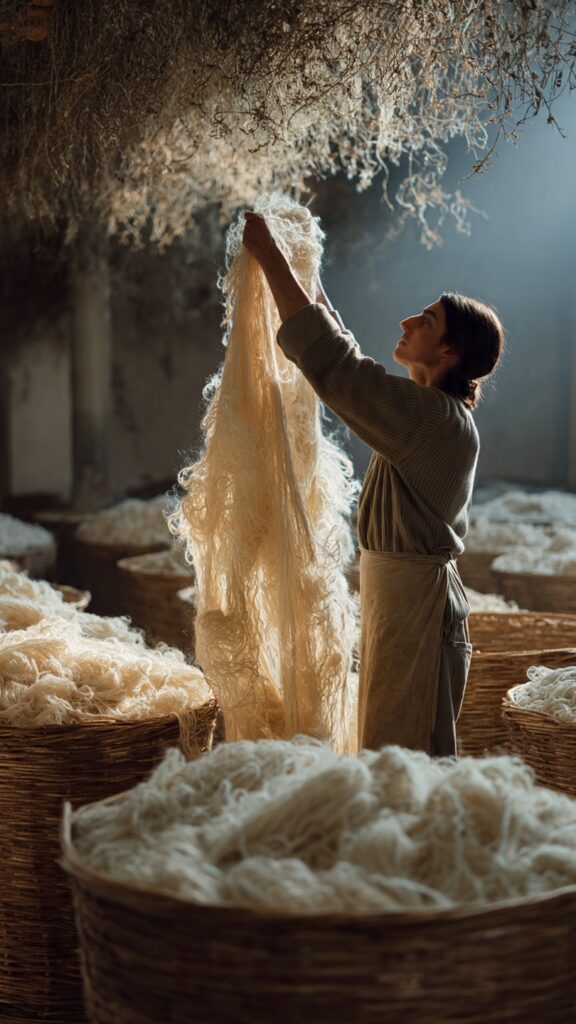
At Malhas do Porto outside Porto, the finishing bath looks like tea. No hazmat suits. No warning signs. Just wool going in and coming out with built-in defense.
“For 40 years we told customers to spray, freeze, and pray. Now we give the sweater its own immune system at the factory. The protection doesn’t wash out because it’s part of the yarn. Customers stopped calling us in about holes,” says Silva.
That’s the shift. From aftercare to built-in care. From disposable to durable.

- THE PROBLEM WE NORMALIZED
For 100 years, the answer to moths was escalation.
First we tried cedar. Then naphthalene balls. Then we sealed sweaters in plastic like crime scenes. Then came the sprays with permethrin — the same chemical used in lice shampoo and mosquito nets.
The global mothproofing chemical market hit $1.2B in 2023, and most of it is still those same neurotoxins. The EU is now reviewing permethrin under REACH because of skin irritation and aquatic toxicity concerns.
We accepted it because the alternative was holes. But we were treating the symptom, not the fiber. And every damaged sweater that got tossed added to the problem.
- THE ACCIDENTAL SOLUTION
The shift didn’t start in fashion. It started in food waste.
The UN FAO estimates 6-8 million tons of shrimp shells are thrown away every year, mostly in Vietnam, India, and Ecuador. For decades that went to landfill and released methane. Then material scientists noticed something: the chitosan in those shells binds to protein. Like wool.
German research institute Fraunhofer IGB began testing chitosan finishes in 2019. By 2022 they proved it made wool taste bitter to webbing clothes moths Tineola bisselliella without any smell to humans.
At the same time, cosmetic chemists were stabilizing thyme and eucalyptus oils to last 50+ washes. Mix the two and you get a finish that moths avoid, bacteria can’t grow on, and humans can’t feel.
Suddenly, waste became an ingredient. Circularity stopped being a buzzword.
- WHY 2026 IS THE TIPPING POINT FOR SUSTAINABLE KNITWEAR
Three things converged:
Regulation: The EU’s Green Claims Directive went live in 2024. Brands can no longer say “sustainable” without proving durability and lower impact. Vague claims get fined.
Waste: Food companies are now paying mills to take shrimp waste. It’s cheaper than landfill fees. Fashion gets a byproduct, seafood gets less waste.
Consumer math: A 2024 LCA study from the University of Leeds found that for wool, 70% of lifetime emissions come from replacing the garment, not making it. If a sweater lasts 5 years instead of 2, you cut its footprint by more than half.
Sustainability used to mean organic cotton. Now it means not buying another one next year.


3 BRANDS DOING THIS NOW
It’s not just mills experimenting anymore. Brands are already shipping it.
Nudie Jeans in Sweden launched merino knits in 2025 finished with chitosan pulled from Nordic shrimp waste and bonded with thyme oil. They list it as “natural moth protection” on the product page, no sprays required.
Asket is doing it at their mill in Porto, Portugal. Their “Lifetime Sweater” line uses the same bio-based finish and comes with a 2-year warranty against holes. The pitch is simple: buy less, wear longer.
And in the UK, Toogood has been testing small-batch cashmere since 2024 using the Fraunhofer IGB process with insect-derived chitosan. They scaled it in 2025 and are now rolling it out across their core knitwear.
All three are skipping chemical sprays entirely and treating the fiber at the factory instead.
- THE LANDFILL MATH NOBODY TALKS ABOUT
The average person in Europe and North America buys 1.7 new sweaters per year. Most get tossed after 2 winters because of pilling, stretching, or holes.
Do the math:
- Old way: 2 years × 1.7 sweaters = 3.4 sweaters to landfill in 4 years
- 2026 way: 5 years × 1.7 sweaters = 1.7 sweaters to landfill in 10 years
That’s 50% less textile waste. And it matters. The Ellen MacArthur Foundation estimates 92 million tons of textile waste are made yearly. Wool in landfill releases methane as it breaks down. Extending garment life is now the #1 lever for fashion’s climate goals.
“Sustainable” isn’t a vibe anymore. It’s a number. And durability is the biggest number.

The greenest sweater isn’t the one made from organic wool. It’s the one you’re still reaching for 5 winters from now. So next time you shop knitwear, change the question. We should not just ask what it is made of but ask how it is protected. If the answer is “by nature,” we’re not just buying warmth, we are buying time and buying less waste.